

What is sexual discretion: meaning, boundaries, and trust
TL;DR:
- Sexual discretion involves mutually managing intimate information to foster trust and emotional safety in relationships. It differs from secrecy, which is driven by fear and damages trust, and from privacy, which supports self-reflection and openness. Practicing clear boundaries and ongoing communication creates a secure space for authentic connection.
Sexual discretion is defined as the conscious, self-protective management of intimate information and behaviour, designed to balance personal privacy with honest, healthy communication in relationships. Think of it as curated vulnerability: you choose what to share, with whom, and when, rather than either oversharing or hiding everything. This concept sits at the heart of psychological safety in intimate partnerships. When both people understand and respect its boundaries, trust deepens and authentic connection becomes possible. Sexual discretion is not about shame or concealment. It is about intentional, mutual care for the private space that intimacy requires.
What is sexual discretion and how does it differ from secrecy?

Sexual discretion, privacy, and secrecy are three distinct concepts that people frequently conflate. Getting the distinction right matters because each one produces a very different relational outcome.
Privacy provides individual space to process thoughts and feelings without external interference. It is self-directed and healthy. A person who keeps a journal about their sexual desires is exercising privacy, not hiding something from their partner. Privacy supports self-care and, paradoxically, supports openness because it gives people room to understand themselves before they communicate.
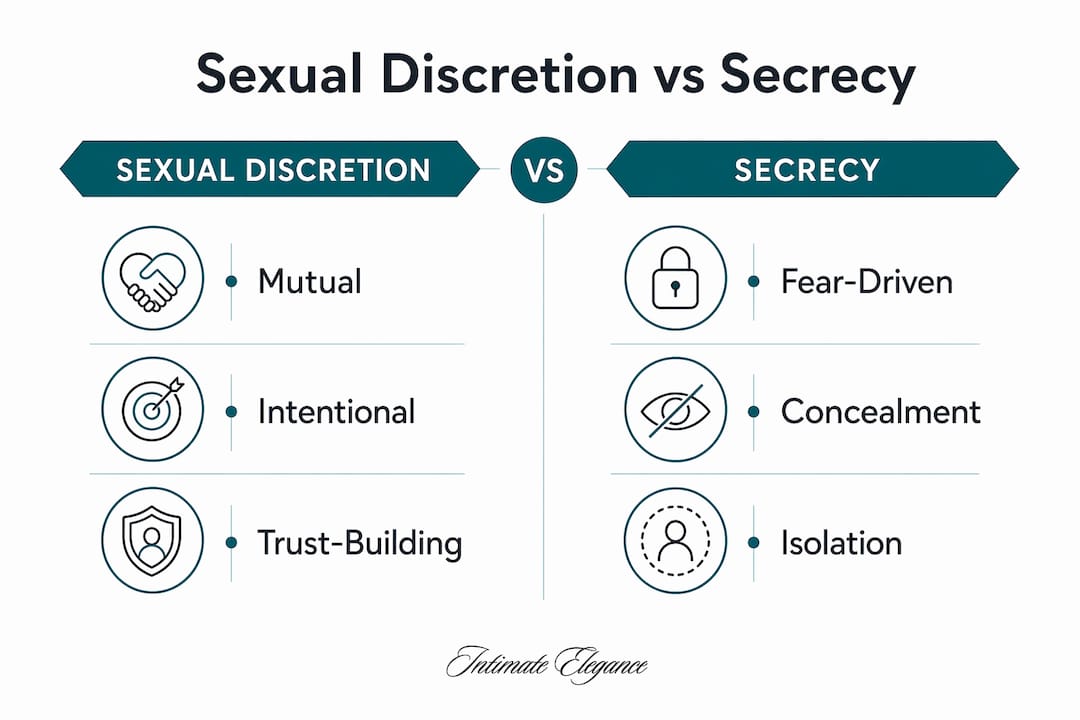
Secrecy, by contrast, is concealment driven by fear, shame, or the desire to control. It acts as a barrier to intimacy rather than a support for it. Intentional discretion is mutual and consistent; shame-based hiding is unilateral and inconsistent. That asymmetry is what makes secrecy corrosive: one partner withholds information in a way that distorts the shared reality of the relationship.
Sexual discretion occupies the space between the two. It is the deliberate, agreed management of intimate information that both partners understand and respect. The table below captures the core differences:
| Concept | Driver | Effect on intimacy |
|---|---|---|
| Privacy | Self-care and reflection | Supports openness over time |
| Secrecy | Fear, shame, or control | Erodes trust and communication |
| Sexual discretion | Mutual, intentional agreement | Builds safety and deeper connection |
The practical implication is clear. Discretion builds trust; secrecy isolates and breaks down communication. Recognising which one is operating in your relationship is the first step towards managing intimate information well.
Why is sexual discretion important in intimate relationships?
Sexual discretion creates an emotional sanctuary. When partners know their vulnerabilities will not be exposed to social networks, colleagues, or family, they explore sexuality more freely without fear of judgement. That freedom is not trivial. It is the condition under which genuine intimacy becomes possible.
The psychological stakes are real. Fear of discretion breaches causes emotional distress and deters people from seeking sexual health care. This means poor discretion does not just damage relationships. It has measurable public health consequences, because people avoid testing, treatment, or honest conversations with healthcare providers when they fear exposure.
Discretion also prevents social stigma. Sexual health information, personal preferences, and intimate habits carry social weight that most people have not chosen to carry publicly. Protecting that information protects dignity. It prevents the kind of psychological trauma that follows unwanted exposure, whether that exposure happens through gossip, social media, or careless conversation.
The benefits of practising discretion well include:
- Psychological safety: Partners feel free to be honest without fearing humiliation.
- Trust accumulation: Consistent discretion signals reliability, which compounds over time.
- Reduced stigma risk: Sensitive health or preference information stays within the relationship.
- Deeper exploration: An emotionally protected space allows both partners to be more adventurous and authentic.
Pro Tip: Most people focus on what not to say about their partner. The more powerful habit is agreeing in advance, as a couple, on what you will and will not share with others. That proactive conversation removes ambiguity and prevents accidental breaches.
Good communication in sexual health is the foundation on which discretion rests. Without honest dialogue between partners, discretion collapses into either secrecy or carelessness.
What are healthy sexual boundaries and how do they support discretion?
Sexual boundaries are the personal limits that define what feels safe, comfortable, and acceptable in intimate contexts. They are not fixed rules. They emerge from personal history, culture, and emotional state, and they shift as relationships develop and individuals grow.
Healthy boundaries function through differentiation: the clearer a person is about their own limits, the more authentically they can show up in a relationship. Differentiation is not distance. It is the opposite. When you know where you end and your partner begins, you can connect intensely without losing yourself. People-pleasing, by contrast, blurs those lines and ultimately produces resentment rather than closeness.
Boundaries empower choice and consent, which are central to authentic intimacy. A boundary is not a wall erected to punish a partner. It is a positive declaration of what you need to feel safe enough to be present. That reframe matters enormously. When partners understand boundaries as enabling rather than restricting, the conversation around them becomes collaborative rather than adversarial.
Key principles of healthy sexual boundaries include:
- Clarity: State what you need directly, without apology or excessive qualification.
- Mutuality: Both partners articulate and respect each other’s limits equally.
- Flexibility: Revisit boundaries as the relationship evolves; what felt necessary at six months may feel different at three years.
- Consent as ongoing practice: Consent is not a single event at the start of a relationship. It is a continuous conversation.
- Non-punitive framing: A boundary protects your wellbeing. It is not a tool for controlling your partner’s behaviour.
Understanding sexual boundaries meaning in this way reframes the entire concept. Boundaries and discretion work together: boundaries define the personal limits, and discretion manages how information about those limits is handled beyond the relationship.
How can couples practise sexual discretion effectively?
Effective sexual discretion begins with curated vulnerability. Rather than reflexively oversharing or defaulting to total silence, curated vulnerability involves active preparation and clear choices about what to share, with whom, and when. This is a skill, not an instinct. It requires deliberate thought.
The first practical step is establishing a mutual discretion agreement. This is a direct conversation in which both partners name what they consider private. Topics might include sexual health history, personal preferences, relationship difficulties, or intimate habits. The agreement does not need to be formal. It needs to be explicit. Assumptions about what a partner will keep private are the most common source of accidental breaches.
Digital contexts require particular attention. Intimate photographs, messages, and browsing histories all carry exposure risk. Agreed protocols around storage, deletion, and access are a straightforward form of practical privacy protection that many couples overlook until something goes wrong.
Discretion in shared social environments is equally important. What you say about your relationship to friends, family, or colleagues shapes how those people relate to your partner. Sharing intimate details, even with good intentions, can alter those dynamics in ways that are difficult to reverse.
Common discretion behaviours that strengthen relationships include:
- Agreeing on what is and is not shared with close friends or family.
- Using secure storage for intimate items or communications.
- Checking in with your partner before discussing relationship details with third parties.
- Treating your partner’s sexual health information as confidential by default.
Pro Tip: The most common pitfall is assuming your partner shares your instincts about privacy. They almost certainly do not. Ask directly: “What would feel like a breach of trust to you?” The answer is often surprising and always worth knowing.
Key takeaways
Sexual discretion is the mutual, intentional management of intimate information that builds trust, protects dignity, and creates the psychological safety required for authentic intimacy.
| Point | Details |
|---|---|
| Definition of sexual discretion | The conscious, self-protective management of intimate information and behaviour within relationships. |
| Discretion versus secrecy | Discretion is mutual and agreed; secrecy is unilateral and driven by fear or control. |
| Psychological benefits | Discretion creates emotional safety, reduces stigma risk, and enables freer sexual exploration. |
| Role of boundaries | Clears, flexible boundaries support discretion by defining what each partner needs to feel safe. |
| Practical application | Curated vulnerability and explicit mutual agreements prevent accidental breaches and build lasting trust. |
Discretion is a form of care, not concealment
People often come to the concept of sexual discretion with a vague sense that it means “keeping things quiet.” That framing undersells it considerably. In my experience, the couples who handle intimacy well are not the ones who share everything or the ones who share nothing. They are the ones who have had the deliberate conversation about what stays between them.
The misconception I encounter most often is that discretion equals deception. It does not. Deception involves distorting reality for someone who has a right to know the truth. Discretion involves protecting information that was never theirs to access in the first place. That distinction is not semantic. It is the difference between a relationship built on trust and one built on anxiety.
What strikes me most about the research on this topic is how consistently it points to the same conclusion: the emotional sanctuary that discretion creates is not a luxury. It is the precondition for genuine intimacy. You cannot be fully present with a partner if you are simultaneously managing the fear that what you share will be broadcast beyond the relationship.
The practical advice I would offer is this: treat discretion as an ongoing dialogue, not a one-time agreement. Relationships change. What felt like an obvious boundary at the start may need revisiting. The couples who do this well check in regularly, adjust their agreements, and treat the conversation itself as an act of care.
— Bartosz
Privacy and pleasure, handled with care at Intimate-elegance
Discretion shapes not just how you communicate, but how you explore. Choosing intimate products with the same care you bring to your private life is a natural extension of that principle.

Intimate-elegance curates premium adult products with anonymous EU-wide shipping and secure transactions, so your choices remain entirely your own. The TOYJOY Amazing Pleasure Sex Toy Kit is a top-rated option for couples who want quality and variety without compromise. For those who prefer elegant lingerie as part of their intimate experience, the Livco Corsetti Linera collection offers craftsmanship that matches the care you bring to every other aspect of your intimate life. Every order arrives discreetly packaged, because your privacy is not an afterthought at Intimate-elegance.
FAQ
What does sexual discretion mean in a relationship?
Sexual discretion means the conscious, mutual management of intimate information and behaviour between partners. It protects psychological safety and builds trust by ensuring that private details remain private.
Is sexual discretion the same as keeping secrets?
Sexual discretion is not the same as secrecy. Discretion is mutual, intentional, and agreed upon by both partners; secrecy is typically unilateral, driven by fear or the desire to control, and erodes trust over time.
Why is sexual discretion important for mental health?
Fear of discretion breaches causes genuine emotional distress and can deter people from seeking sexual health care. Effective discretion protects dignity, reduces stigma, and prevents the psychological harm that follows unwanted exposure.
How do sexual boundaries support discretion?
Sexual boundaries define what each person needs to feel safe in an intimate context. When both partners understand and respect those limits, managing intimate information discreetly becomes a natural extension of that mutual respect.
How can I practise sexual discretion with my partner?
Start with an explicit conversation about what each of you considers private. Agree on what will not be shared with friends, family, or online. Revisit that agreement as your relationship evolves, and treat the conversation itself as an act of care.
Recommended
- Adult intimacy checklist: your complete 2026 guide – Intimate Elegance
- Privacy in adult shopping: your complete 2026 guide – Intimate Elegance
- Your ultimate intimate wellness checklist: health and privacy – Intimate Elegance
- Secure sex toy buying steps for discreet, quality pleasure – Intimate Elegance