

The role of online guides in sexual well-being
TL;DR:
- Online guides provide evidence-based sexual health information accessible to adults worldwide to support their well-being. They complement professional care by offering reliable, inclusive, and privacy-conscious resources, especially for underserved populations. The most effective guides address consent, communication, and relationships, encouraging curiosity-driven use for lasting positive impact.
Online guides are defined as digital resources that provide evidence-based information on sexual health, intimacy, and pleasure to adults seeking to improve their well-being outside clinical settings. The role of online guides in sexual well-being is to make trustworthy, accessible information available to anyone who needs it, regardless of geography, circumstance, or confidence level. Research shows 53% of people use the internet as a primary source for sexual and reproductive health information. That figure reflects a fundamental shift in how adults learn about their bodies, relationships, and desires. Experts consistently position these resources as a complement to professional care, not a replacement for it.
What is the role of online guides in sexual well-being?
Online sexual well-being guides serve as the first point of contact for millions of adults who would not otherwise seek clinical help. They cover everything from anatomy and contraception to consent, communication, and pleasure. The industry term for this category is digital sexual health intervention, and it spans a wide range of formats and delivery methods.

The most common formats include dedicated educational websites, digital sexual health services, mobile apps, and AI-powered chatbots. Each format carries a different level of reliability. 85% of people trust specialised educational and consultation sites over social media or AI-generated content. That gap in trust is significant. It tells you that adults are already making quality distinctions between sources, even if they lack a formal framework for doing so.
| Guide type | Strengths | Weaknesses |
|---|---|---|
| Educational websites | Expert-authored, evidence-based, stable content | Can feel clinical or inaccessible |
| Digital health services | Structured, often clinician-reviewed | Limited interactivity, registration barriers |
| Mobile apps | Accessible, personalised, discreet | Variable quality, data privacy concerns |
| AI chatbots | Available 24/7, non-judgemental | Safety and accuracy issues compared to human-led resources |
| Social media content | Relatable, shareable, current | Low trust ratings, high misinformation risk |
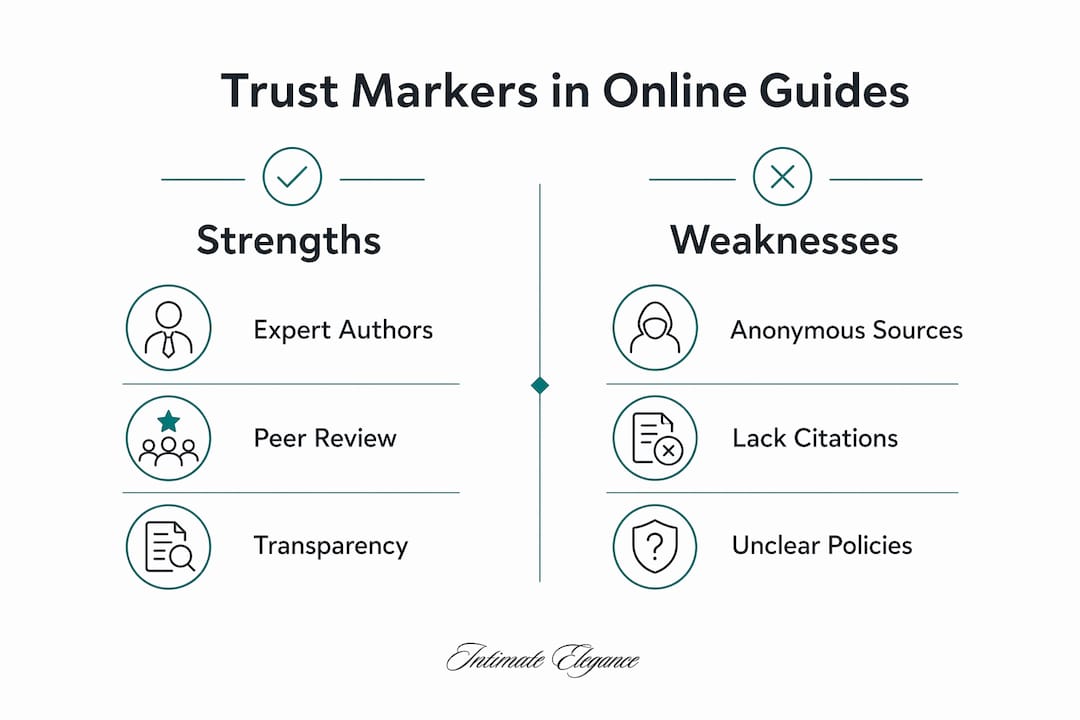
The clearest trust markers for any online guide are expert authorship, citations from peer-reviewed sources, a transparent privacy policy, and content that avoids sensationalism. Guides that frame sexual health as performance or attractiveness are a red flag. Guides that address consent, communication, and diverse identities are a strong signal of quality.
Pro Tip: Before relying on any online sexual health resource, check whether the author is a named clinician, psychologist, or accredited health organisation. Anonymous content with no editorial accountability carries a much higher risk of inaccuracy.
How do online guides impact sexual well-being?
The benefits of digital sexual health resources are well-documented and specific. Anonymous access removes the fear of judgement that stops many adults from seeking help in person. Anonymous, inclusive digital guides act as a critical doorway to sexual healthcare for people who feel stigma or fear in clinical settings. That function is irreplaceable. No GP appointment or pharmacy visit offers the same privacy.
Benefits worth knowing
- Stigma reduction: Adults can research sensitive topics, including sexual dysfunction, STI symptoms, or non-normative desires, without social exposure.
- Knowledge empowerment: Access to clear, accurate information supports better decision-making about contraception, consent, and pleasure.
- Inclusivity: Well-designed guides reach people who are underserved by traditional healthcare, including LGBTQ+ adults and those with disabilities.
- Flexibility: User-driven content selection in digital interventions enhances autonomy and positively influences sexual well-being outcomes.
Limitations that matter
The limitations are equally real. AI chatbots, despite their growing popularity, face documented challenges in delivering comprehensive and reliable sexual health guidance. Digital health services often fail to close existing access gaps. Studies show that digital platform users mostly reflect existing in-person service users, meaning the people who most need support are often still not reached.
Socioeconomic factors and digital literacy levels create persistent barriers. Women show a utilisation rate of 2.23% for digital sexual health services compared to just 0.12% for men. That disparity does not mean women are better served. It reflects different patterns of health-seeking behaviour and highlights that equitable access remains an unresolved challenge.
Safety is another concern. 20.3% of young people encounter unwanted sexual content online, and 11.5% receive unwanted sexual solicitations. Those numbers underline why digital literacy and safe navigation skills are not optional extras. They are core to using online sexual health resources responsibly.
Pro Tip: Use guides from organisations with a clear editorial policy and a named medical advisory board. If a site earns revenue from product sales alone and provides no clinical oversight, treat its health content with caution.
What topics do effective sexual well-being guides cover?
The best digital sexual health resources go well beyond anatomy. Many guides focus narrowly on physical or performance aspects, overlooking the relational skills that genuinely shape sexual well-being. That gap is one of the most consistent criticisms from researchers in this field.
Effective guides address the following areas:
- Consent and communication: Clear, ongoing consent is the foundation of healthy sexual relationships. Guides that treat consent as a checklist rather than a continuous conversation miss the point entirely.
- Sexual preferences and identity: Quality resources acknowledge the full spectrum of sexual orientation and gender identity without pathologising difference.
- Couple-orientated guidance: Relationship dynamics, desire discrepancy, and shared pleasure are topics that affect most adults at some point. Guides that address these with nuance are far more useful than those focused on individual performance.
- Sexualised violence awareness: Recognising coercive behaviour, understanding boundaries, and knowing where to seek help are topics that belong in any credible sexual well-being resource.
- Realistic contextual information: Good guides present sex as a normal, varied, and sometimes complicated part of adult life, not a performance standard to be met.
Communication skills are consistently identified as one of the most underdeveloped areas in digital sexual health content. Adults who can articulate their needs and boundaries report higher satisfaction in intimate relationships. Guides that teach these skills deliver lasting value, not just information.
The format of delivery also matters. Multimedia content, including video, interactive quizzes, and illustrated guides, tends to improve engagement and retention compared to text-only resources. The most effective guides combine clinical accuracy with accessible, human-centred storytelling.
How to use online sexual health guides effectively
Critical appraisal is the first skill to develop. Not all online sexual health resources are created equal, and the volume of available content makes quality assessment non-negotiable.
- Check authorship and credentials. Look for named authors with relevant qualifications. A guide written by a sexual health nurse or clinical psychologist carries more weight than anonymous content.
- Look for evidence-based claims. Reliable guides cite research, reference clinical guidelines, or link to peer-reviewed sources. Vague claims without evidence are a warning sign.
- Assess inclusivity. The best resources reflect diverse bodies, identities, and relationship structures. If a guide assumes a single demographic, its advice will be limited.
- Protect your privacy. Use private browsing when researching sensitive topics. Check the site’s privacy policy before creating an account or sharing personal data. Effective use of online guides requires attention to privacy, accessibility, and user confidence from the outset.
- Integrate with professional care. Online guides work best alongside, not instead of, clinical support. If a guide raises questions you cannot answer alone, take those questions to a GP, sexual health clinic, or therapist.
Personalisation is the final piece. Flexible, user-driven content helps adults feel supported rather than lectured. Choose resources that let you set your own pace and focus on the topics most relevant to your life. Understanding sexual empowerment as a personal process, rather than a destination, makes the difference between passive reading and genuine change.
Pro Tip: Multimedia formats, including video explainers and interactive self-assessments, consistently outperform text-only guides for engagement and knowledge retention. Prioritise resources that offer more than one content format.
Key takeaways
Online guides are most effective when they are evidence-based, inclusive, and used alongside professional care rather than as a substitute for it.
| Point | Details |
|---|---|
| Trust specialised sources | Educational and consultation sites are trusted by 85% of users, far ahead of social media or AI chatbots. |
| Recognise access gaps | Women use digital sexual health services at a far higher rate than men, but socioeconomic barriers still limit equitable access. |
| Prioritise relational content | Effective guides cover consent, communication, and relationship dynamics, not just anatomy or performance. |
| Protect your privacy | Use private browsing and check privacy policies before engaging with any online sexual health platform. |
| Complement, do not replace, clinical care | Online guides work best as a supplement to professional advice, particularly for complex or ongoing health concerns. |
Why I think most adults are using online sexual health guides wrong
The conversation around digital sexual health resources tends to focus on whether the content is accurate. That is the right question, but it is only half the problem. The other half is how adults actually engage with what they find.
Most people arrive at an online guide mid-crisis: a new symptom, a relationship difficulty, or a question they feel too embarrassed to ask a doctor. They read one article, find a partial answer, and stop there. That reactive pattern means they rarely build the broader understanding that would genuinely improve their well-being over time.
The guides that work best are the ones that treat adults as capable of handling complexity. They do not simplify consent into a single paragraph or reduce pleasure to a list of techniques. They acknowledge that sexual well-being is connected to mental health, relationship quality, and self-knowledge. Resources that reflect that complexity, such as those addressing sexual self-expression as part of a broader identity, tend to produce more lasting engagement.
My honest observation after years in this space: the adults who benefit most from online guides are those who approach them with curiosity rather than urgency. They use digital resources to build vocabulary and confidence, then carry those tools into real conversations with partners or clinicians. That is the model that actually works.
— Bartosz
What Intimate-elegance offers beyond information
Intimate-elegance combines editorial depth with a curated product range designed for adults who take their sexual well-being seriously.
The Intimate-elegance blog covers topics from communication and consent to product guidance, giving you the context to make informed choices. When you are ready to move from reading to doing, the product range is there to support you. The TOYJOY Amazing Pleasure Sex Toy Kit is a strong starting point for couples or individuals exploring pleasure with quality products. For those interested in couples’ accessories, the double penis ring with clitoral stimulator offers a practical way to bring guide-informed knowledge into shared experience. All orders ship discreetly across the EU with full privacy protection.
FAQ
What are online guides in sexual well-being?
Online guides in sexual well-being are digital resources that provide evidence-based information on sexual health, intimacy, consent, and pleasure. They function as digital sexual health interventions, ranging from educational websites to mobile apps and AI chatbots.
Are online sexual health guides trustworthy?
Trustworthiness depends on the source. Specialised educational and consultation sites are trusted by 85% of users, while social media content and AI-generated material carry significantly lower credibility ratings.
Can online guides replace professional sexual healthcare?
Online guides are best used as a complement to professional care, not a replacement. Experts advocate for digital resources that are method-neutral and life-stage appropriate, with clinical support for complex or ongoing concerns.
What topics should a good sexual well-being guide cover?
A quality guide covers consent, communication, sexual identity, relationship dynamics, and sexualised violence awareness. Guides that focus solely on physical performance or anatomy are considered incomplete by current research standards.
How do I protect my privacy when using online sexual health resources?
Use private browsing mode, review the site’s privacy policy before registering, and avoid platforms that share personal data with third parties. Effective use of online sexual health guides requires intentional attention to privacy from the first visit.