

The role of education in intimacy: what adults need to know
TL;DR:
- Education influences intimacy by improving communication, emotional literacy, and sexual health knowledge across all life stages.
- Shared educational backgrounds foster compatibility and better relationship dynamics, but active learning can bridge gaps between mismatched partners.
Education is the single most underrated driver of intimate connection, shaping how adults communicate desire, select partners, and sustain emotional bonds across a lifetime. The role of education in intimacy spans far beyond classroom sex ed. It includes the vocabulary you use to describe your body, the emotional intelligence you bring to conflict, and the shared intellectual framework you build with a partner. Adults who invest in sexual health knowledge, communication skills, and emotional literacy report measurably better relationships. This guide explains why, and what you can do about it.
How does formal sexual health education improve intimacy?
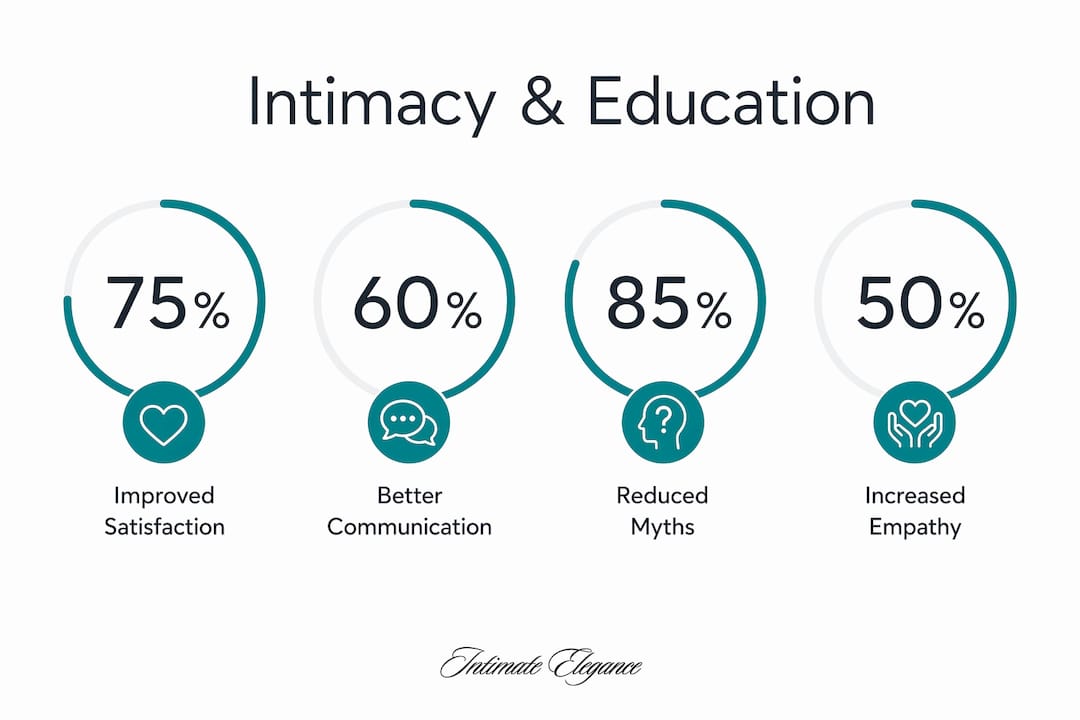
Sexual health education directly improves sexual quality of life. A clinical study found that participants in a structured sexual health training programme showed significant improvements in sexual quality of life scores and a measurable reduction in belief in sexual myths. That matters because myths about performance, anatomy, and desire are among the most common sources of shame and miscommunication in adult relationships.
The benefits extend well beyond adolescence. The same research demonstrated that sexual health education during pregnancy improved sexual function and quality of life scores among adult women. This shows that education is not a one-time intervention for teenagers. It is an ongoing resource that produces real gains at every life stage.
Comprehensive sexuality education (CSE) also changes behaviour. A review of twelve studies on formal sex instruction found consistent improvements in sexual health literacy and protective behaviours. Better literacy means adults can name what they want, recognise what they do not want, and communicate both clearly to a partner.
Key benefits of formal sexual health education for adults include:
- Reduced belief in harmful sexual myths that distort expectations
- Improved ability to name physical needs and boundaries
- Greater confidence discussing sexual health with both partners and clinicians
- Higher scores on validated measures of sexual satisfaction
Pro Tip: If you missed comprehensive sex education growing up, structured online courses from certified sexual health educators, such as those offered through the American Association of Sexuality Educators, Counselors and Therapists (AASECT), are a practical starting point for adults.
Does educational background affect who you choose as a partner?
Educational homogamy is the tendency to select romantic partners with similar levels of formal education. It is one of the strongest patterns in partner selection research. People with no formal education are 80 times more likely to partner with someone at the same level. Doctoral degree holders are nearly 15 times more likely to do the same. These are not small statistical tendencies. They represent a near-universal social force.
The reason this matters for intimacy is that shared educational background often produces shared intellectual frameworks. Couples with similar education levels tend to approach problem-solving, communication, and long-term planning in compatible ways. Marriages between people with similar education have increased over recent decades, reflecting both social sorting and a growing premium placed on intellectual compatibility.
The table below shows how educational matching shapes relationship dynamics.
| Educational dynamic | Effect on intimacy |
|---|---|
| Matched education levels | Shared communication styles, fewer power imbalances |
| Significant education gap | Risk of resentment or condescension without active effort |
| Different fields of study | Complementary perspectives, potential for richer dialogue |
| Ongoing learning by both partners | Reduces gap effects; builds mutual respect |
Mismatched education does not doom a relationship. Open communication and lifelong learning prevent resentment despite educational differences. The critical variable is not the degree on the wall. It is the willingness to keep learning together.
What is intimacy literacy and why does it matter?
Intimacy literacy is the ability to name, discuss, and advocate for your emotional and physical needs within a relationship. It is distinct from academic education, though it is shaped by it. Adults who lack proper anatomical vocabulary cannot advocate for themselves effectively, which creates blind spots in both clinical care and intimate communication.
The consequences are concrete. Without words for what you feel or where you feel it, you cannot tell a partner what brings you pleasure or what causes discomfort. You cannot describe a symptom to a doctor. You cannot set a boundary with precision. Precise anatomical terminology reduces shame, improves sexual satisfaction, and leads to better healthcare outcomes. Language is not just a communication tool. It is a form of self-knowledge.
Emotional intelligence sits alongside vocabulary as a pillar of intimacy literacy. Adults who can identify and name their own emotional states, and respond to a partner’s, navigate conflict and vulnerability far more effectively. This is a learnable skill, not a fixed trait. Resources like the work of Dr. John Gottman at the Gottman Institute have produced evidence-based frameworks for building exactly this kind of emotional fluency in couples.
Four practical steps to build intimacy literacy:
- Learn anatomical vocabulary. Use medically accurate terms for your own body. Read reputable sexual health resources such as those from the NHS or Planned Parenthood to fill gaps from inadequate early education.
- Practise naming emotions. Keep a brief daily log of emotional states using a feelings wheel. This builds the vocabulary needed for honest conversations with a partner.
- Have structured check-ins. Set aside ten minutes weekly to discuss what is working and what is not in your relationship. Consistency matters more than duration.
- Read together. Shared reading on intimacy, such as guides on modern intimacy and connection, creates a common language and opens conversations that might not arise otherwise.
Pro Tip: The fastest way to improve intimate communication is to replace vague language (“I feel weird about this”) with specific language (“I feel anxious when we don’t talk after an argument”). Specificity is the foundation of genuine connection.
Practical ways to use education to enhance intimacy
Adults can actively use educational resources to improve their intimate relationships. The approach works best when it combines formal knowledge with consistent practice and, where relevant, physical tools that reinforce learning.

Start with self-directed sexual health education. Many adults never received adequate sex education in school, which means gaps in knowledge about anatomy, pleasure, and consent persist well into adulthood. Filling those gaps through books, certified online courses, or reputable health websites produces immediate practical benefits. Understanding how arousal works, for example, removes performance pressure and replaces it with curiosity.
Communication exercises build intimacy faster than most couples expect. Exercises like the “36 Questions” developed by psychologist Arthur Aron at the State University of New York at Stony Brook have been shown to accelerate emotional closeness between strangers and partners alike. The mechanism is simple: structured self-disclosure builds trust. Trust deepens intimacy. Practising this kind of guided conversation regularly is a form of relational education.
Physical tools also support learning. Adult products used intentionally, with discussion before and after, teach couples about their own responses and preferences. This is not incidental. It is applied education. Guides on how adult toys enhance relationships make the case that physical exploration, when paired with open communication, is one of the most direct routes to deeper intimacy.
The comparison below shows the difference between passive and active approaches to intimacy education.
| Approach | Method | Outcome |
|---|---|---|
| Passive | Hoping intimacy improves over time | Stagnation, unaddressed needs |
| Active (knowledge only) | Reading about intimacy without discussion | Improved awareness, limited change |
| Active (knowledge + communication) | Learning together and discussing openly | Shared language, stronger connection |
| Active (knowledge + tools + communication) | Combining education, conversation, and physical exploration | Deepest and most sustained improvement |
Ongoing education is the differentiator. Couples who treat intimacy as a skill to develop, rather than a state to maintain, consistently report higher satisfaction over time.
Key takeaways
Education shapes intimacy through sexual health knowledge, emotional vocabulary, and communication skills, and adults who invest in all three report the strongest and most lasting intimate connections.
| Point | Details |
|---|---|
| Sexual health education works at any age | Formal training improves sexual quality of life and reduces harmful myths at every life stage. |
| Educational homogamy is powerful | People strongly favour partners with similar education levels, affecting communication and relationship stability. |
| Intimacy literacy is learnable | Building anatomical vocabulary and emotional language directly improves self-advocacy and partner communication. |
| Active learning beats passive hope | Combining knowledge, structured conversation, and physical exploration produces the deepest intimacy gains. |
| Lifelong learning bridges gaps | Couples with different educational backgrounds can thrive through shared curiosity and open dialogue. |
Why I think we’ve been thinking about intimacy education all wrong
Most conversations about sex education focus on teenagers. That framing misses the point entirely. The adults who struggle most with intimacy are not those who lack desire. They are those who lack language. They never learned to name what they want, ask for what they need, or hear a partner’s needs without defensiveness.
I’ve seen this pattern repeatedly. Couples who are genuinely fond of each other hit a wall because one or both partners cannot articulate their inner experience. They feel something, but they cannot say it. That gap, between feeling and language, is an educational gap. It is not a character flaw. It is a skill that was never taught.
What surprises people is how quickly this changes with deliberate effort. Learning the correct anatomical terms, reading a single well-researched book on emotional communication, or even using a structured conversation exercise once a week produces noticeable shifts within weeks. The investment is small. The return is significant.
The other thing I’d push back on is the idea that educational differences between partners are inherently problematic. They are not. What matters is whether both people value learning and treat each other’s intelligence with respect. A partner who reads widely and thinks carefully is an intellectual equal regardless of their formal qualifications. Intimacy thrives on curiosity, not credentials.
Prioritise education as a relational practice, not a one-off event. The couples who do this consistently are the ones who still have things to say to each other after twenty years.
— Bartosz
Products that put your learning into practice
Knowledge about intimacy is most powerful when it is paired with experience. Intimate-elegance curates premium adult products designed for couples and individuals who approach pleasure with intention and curiosity.

The TOYJOY Amazing Pleasure Sex Toy Kit is a well-regarded starting point for couples who want to explore together, combining variety with quality in a single set. For those seeking targeted stimulation, the ID Pleasure water-based lubricant complements physical exploration with comfort and sensitivity. Every order ships discreetly across the EU. Intimate-elegance also publishes a practical guide on enhancing pleasure for adults who want to connect their reading to real experience.
FAQ
Does education really affect sexual satisfaction?
Yes. Sexual health training improves sexual quality of life and reduces belief in sexual myths, both of which directly affect satisfaction. Adults who receive structured sexual health education report better sexual function and communication.
What is intimacy literacy?
Intimacy literacy is the ability to name and communicate your emotional and physical needs within a relationship. It includes anatomical vocabulary, emotional language, and the communication skills needed to advocate for yourself with a partner and with healthcare providers.
Can couples with different education levels have strong intimacy?
Yes. Valuing diverse intelligences and maintaining open communication are the key factors. Educational differences create challenges only when they lead to condescension or a reluctance to keep learning together.
How does vocabulary improve intimacy?
Precise anatomical and emotional vocabulary reduces shame and improves self-advocacy. Adults who can name what they feel and where they feel it communicate more clearly with partners, which leads to higher satisfaction and fewer unresolved misunderstandings.
Is sex education only relevant for young people?
No. Research shows that comprehensive sexuality education improves knowledge and behaviour at any age. Adults benefit from ongoing sexual health learning throughout their lives, including during major life transitions such as pregnancy or new relationships.