

How to explore new kinks safely: a 2026 guide
TL;DR:
- Kink exploration involves consensually trying new sensations or power dynamics with clear communication and mutual agreement. Preparing with self-knowledge, safety tools, and a gradual approach reduces risks and enhances the experience. Open, honest dialogue and respectful pacing build trust and deepen intimate connections.
Kink exploration is defined as the consensual practice of introducing new sexual interests, sensations, or power dynamics into your intimate life. Knowing how to explore new kinks well means starting with communication, not experimentation. The German Bundesrat’s endorsement of the “Yes means Yes” principle established explicit, enthusiastic consent as the legal standard for sexual activity, and that same standard applies here. Curiosity is healthy. Acting on it responsibly, with clear boundaries and mutual agreement, is what separates enriching exploration from harmful experience.
What prerequisites and tools support safe kink exploration?
Safe kink exploration begins with self-knowledge, not accessories. Before you introduce anything new to a partner, you need a clear picture of your own desires and limits.

The “Yes, No, Maybe” list is the most practical starting point. Write three columns: things you actively want to try, things you refuse outright, and things you are open to discussing. Completing this list alone first, then sharing it with a partner, removes the awkwardness of real-time negotiation and gives both of you a written reference point.
Emotional readiness matters as much as physical preparation. Solo exploration through fantasy, journaling, or guided audio erotica lets you test your reactions privately before involving anyone else. You learn what genuinely excites you versus what sounds appealing in theory but feels uncomfortable in practice.
Physical safety requires practical tools:
- Safe words: Agree on a clear stop word (many people use the traffic-light system: “green,” “amber,” “red”) before any session begins.
- Barrier methods: Condoms and dental dams remain essential. Annual STI screenings are the recommended minimum for sexually active adults. PrEP prevents HIV but not other STIs, so barrier protection stays non-negotiable.
- Sensory accessories: Feather ticklers, blindfolds, and restraints allow gentle experimentation with sensation and control without significant physical risk.
- Aftercare supplies: Water, a blanket, and time set aside for emotional check-ins after a session are not optional extras. They are part of the session itself.
Pro Tip: Complete your “Yes, No, Maybe” list before any conversation with a partner. It takes 20 minutes and prevents hours of awkward mid-session negotiation.
| Tool | Purpose |
|---|---|
| “Yes, No, Maybe” list | Maps desires and hard limits before discussion |
| Safe words | Provides an instant, unambiguous stop signal |
| Annual STI screening | Maintains sexual health as exploration broadens |
| Sensory accessories | Enables low-risk experimentation with sensation |
| Aftercare plan | Protects emotional wellbeing after intense sessions |
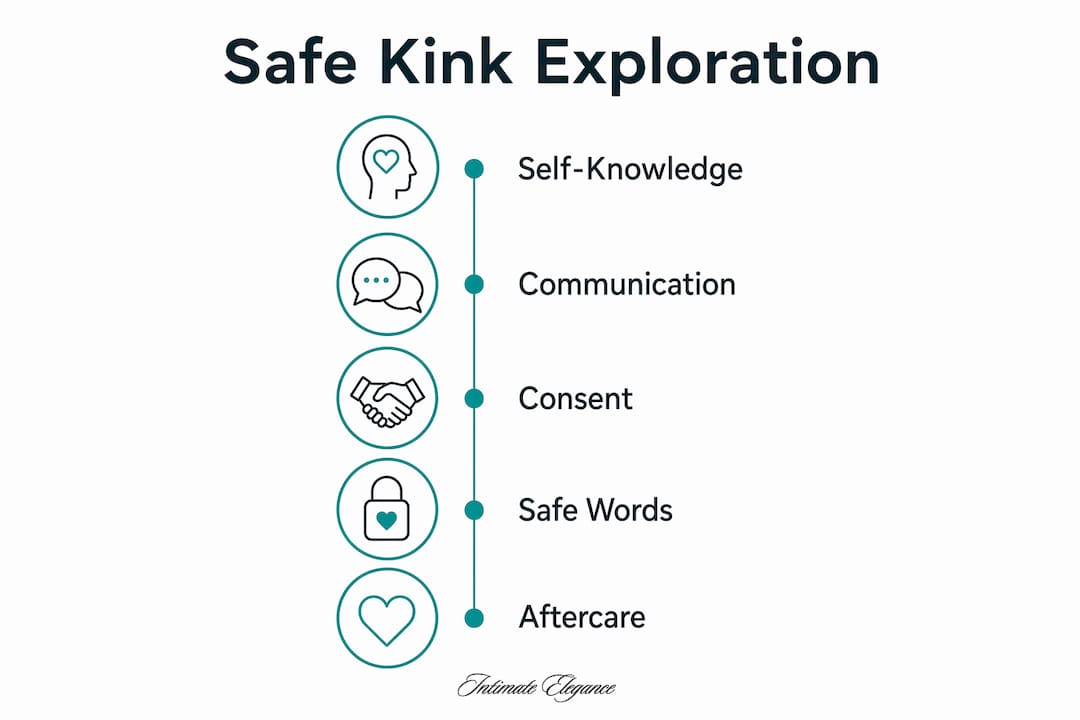
How to introduce and try new kinks with a partner
Timing and environment shape the entire conversation. Raising a new kink mid-argument or immediately before sex sets it up to fail. A calm, distraction-free moment, such as a quiet evening meal or a relaxed walk, creates the psychological safety both partners need to speak honestly.
Language is the most underrated tool in this process. Framing requests as shared explorations rather than personal demands reduces resistance and builds intimacy. “I’d love to discover this with you” lands very differently from “I want to do this.” The first invites; the second pressures. Reframing around “we” and “us” signals that you see this as a mutual experience, not a personal agenda.
Once you have had the initial conversation, follow these steps before your first session:
- Agree on a safe word. Use something memorable and unambiguous. The traffic-light system works well for beginners because it allows gradation: “amber” means slow down, “red” means stop completely.
- Set explicit boundaries. Discuss what is on the table for this specific session only. Consent for one activity does not imply consent for anything adjacent.
- Start at the lowest intensity. If you are curious about sensation play, begin with a feather tickler rather than wax. If you are interested in restraint, try holding wrists gently before introducing any equipment.
- Check in during the session. A simple “How are you feeling?” keeps communication open and signals that stopping is always acceptable.
- Debrief afterwards. Discuss what worked, what did not, and what you might adjust. This debrief is where trust is built, not during the act itself.
Pro Tip: Schedule your debrief for at least 30 minutes after the session ends. Immediate reactions are often emotional rather than reflective. Waiting gives both partners time to process.
Clear boundaries, safe words, and aftercare are the three pillars of responsible kink. Skipping any one of them increases the risk of emotional harm, even when physical safety is maintained. Understanding the role of communication in sexual health is the single most useful preparation you can do before any new experience.
How can solo exploration help in discovering personal kinks?
Solo kink exploration is an underused safety net. It lets you experiment with desires privately, without consent complications or the pressure of a partner’s reaction. Many people skip this step and go straight to partner experimentation, which means they arrive without a clear sense of their own limits.
Practical solo techniques include:
- Fantasy journaling: Write out scenarios without censoring yourself. The act of writing often clarifies what genuinely appeals versus what you imagined would appeal.
- Guided audio erotica: Audio formats allow you to engage with a scenario passively and notice your physical and emotional responses without visual distraction.
- Controlled toy use: Experimenting with sensation tools alone, such as a feather tickler or a vibrator on different settings, teaches you your body’s responses before you share that information with a partner.
- Mindful reflection: After any solo session, spend five minutes noting what felt good, what felt neutral, and what felt uncomfortable. This data becomes your personal kink map.
Solo exploration honours consent even with yourself. It is a practice of listening to your own body without external pressure, and it builds the self-awareness that makes partnered exploration safer and more satisfying for everyone involved.
Signs that professional support might be useful include persistent distress about your desires, compulsive fantasy patterns that interfere with daily life, or a strong sense of shame that solo reflection does not resolve. Sex-positive therapy creates a space to explore desires without judgement, shifting the focus from “What is wrong with me?” to understanding and integrating your authentic sexuality.
Common mistakes to avoid when exploring new kinks
Most problems in kink exploration come from rushing, not from the kinks themselves. The following mistakes are the most common, and the most avoidable.
- Skipping the conversation. Attempting a new kink without prior discussion, even a brief one, removes consent from the equation entirely. No amount of enthusiasm in the moment replaces an explicit prior agreement.
- Confusing a fantasy with a fixed desire. Some persistent fantasies reflect emotional regulation needs rather than purely sexual ones. Recognising this distinction prevents you from pursuing an experience that will not actually satisfy the underlying need.
- Treating initial consent as permanent. Consent applies to each session and can be withdrawn at any point. Checking in regularly, not just at the start, keeps both partners genuinely safe.
- Neglecting aftercare. Aftercare is not a reward for a good session. It is a psychological necessity, particularly after any experience involving power dynamics or intense sensation. Skipping it leaves partners feeling disconnected or confused.
- Escalating too quickly. Approaching kink exploration slowly with ongoing enthusiastic consent makes the experience more rewarding and respectful. Gradual escalation also makes it easier to identify exactly where your genuine comfort zone sits.
- Ignoring your partner’s pace. One partner’s enthusiasm does not set the speed for both. If one person needs more time, that pace takes priority without negotiation.
Recognising when to seek a sex-positive therapist or counsellor is a sign of self-awareness, not failure. Responsible intimacy education consistently reinforces that professional support is a tool, not a last resort.
Key takeaways
Safe, satisfying kink exploration requires enthusiastic consent, honest communication, and a gradual approach that respects both partners’ pace and limits at every stage.
| Point | Details |
|---|---|
| Consent is non-negotiable | Explicit, enthusiastic agreement must precede every new activity, every time. |
| Prepare before you experiment | Complete a “Yes, No, Maybe” list and agree on safe words before any session. |
| Solo exploration builds self-knowledge | Journalling and private toy use clarify your desires before involving a partner. |
| Aftercare is part of the session | Emotional check-ins after play protect wellbeing and build lasting trust. |
| Slow escalation works best | Starting at low intensity and increasing gradually reduces risk and improves satisfaction. |
What I have learned from watching people get this wrong
I have spent years reading, writing about, and discussing sexual wellness with adults across a wide range of experience levels. The pattern I see most often is not recklessness. It is impatience combined with silence.
People assume that desire is self-explanatory. They think that if they want something strongly enough, the wanting itself communicates the what, the how, and the why to their partner. It does not. Desire is private until you articulate it, and articulating it well is a skill that takes deliberate practice.
The “we/us” framing is not just a communication tip. It is a psychological reframe. When you say “I want to try this,” you place the entire weight of the desire on yourself and implicitly ask your partner to respond to your need. When you say “I’d love to explore this with you,” you create a shared project. The difference in how partners receive those two framings is significant and consistent.
What I find genuinely encouraging is how much curiosity adults bring to this topic when they feel safe enough to ask. The barrier is rarely desire. It is the fear of being judged, misunderstood, or rejected. A calm conversation, framed well, removes most of that fear before a single boundary has been set.
Kink does not deepen relationships despite its complexity. It deepens them because of it. Navigating something unfamiliar together, with honesty and care, builds a kind of trust that ordinary intimacy rarely demands.
— Bartosz
Sensory tools for your first steps with Intimate-elegance
Gentle sensation play is one of the most accessible entry points for kink beginners, and the right tool makes a real difference to how comfortable that first experience feels.

Intimate-elegance stocks a curated range of feather ticklers designed for exactly this kind of careful, playful experimentation. The KINK ostrich feather tickler at 19 cm offers precise, light sensation ideal for first sessions. For those ready for a longer reach and more varied texture, the horn-shaped chicken feather tickler at 36 cm and the ruffled feather tickler at 48 cm offer progressively richer sensory experiences. All orders ship discreetly across the EU with secure, anonymous packaging.
FAQ
What does kink exploration mean?
Kink exploration is the consensual practice of introducing new sexual interests, sensations, or dynamics into your intimate life. It requires explicit agreement from all involved before any activity begins.
How do I bring up a new kink with my partner?
Choose a calm, neutral moment away from the bedroom and use inclusive language such as “I’d love to discover this with you.” Framing the conversation around shared discovery reduces pressure and invites genuine dialogue.
What is a safe word and why does it matter?
A safe word is a pre-agreed signal that stops or pauses a session immediately. Safe words give both partners a clear, unambiguous way to communicate discomfort without breaking the mood of a scene.
How often should I get tested when exploring new kinks?
Health authorities recommend at least annual STI screenings for sexually active adults. If you are broadening your sexual activity, more frequent testing is advisable alongside consistent barrier protection.
When should I consider sex-positive therapy?
Seek a sex-positive therapist if your desires cause persistent distress, interfere with daily life, or feel compulsive rather than pleasurable. Sex-positive therapy helps integrate desires with less shame and supports healthier self-expression.