

Communication in sexual health: what adults need to know
TL;DR:
- Open, honest sexual communication is the most reliable predictor of relationship satisfaction and emotional safety. Regular, low-pressure conversations build trust, reduce shame, and improve consent, leading to healthier sexual and emotional connections. Prioritizing ongoing dialogue over formal talks fosters deeper intimacy and better overall relationship health.
Open, honest dialogue is the single most powerful tool for sexual health and relationship satisfaction. The role of communication in sexual health extends far beyond discussing contraception or STI testing. A meta-analysis of 93 studies involving nearly 40,000 individuals found that sexual communication predicts relationship and life satisfaction more reliably than sexual frequency or novelty. That finding reframes everything. The quality of your conversations matters more than the quantity of your encounters. Entities including the CDC, UNESCO, and UC Davis Health all point to the same conclusion: talking openly about sex is a life skill, not an awkward obligation.
How does effective communication improve sexual health?
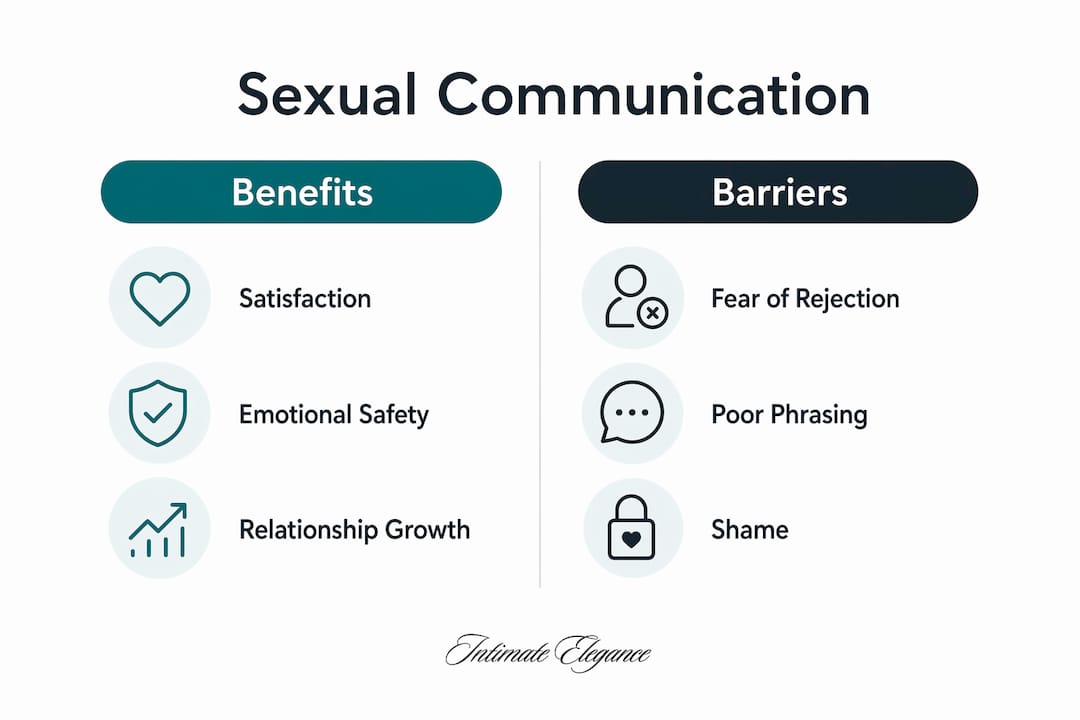
Sexual communication is the strongest single predictor of sexual and relationship satisfaction. That claim comes from a Psychology Today meta-analysis covering nearly four decades of research across tens of thousands of couples. The implication is direct: if you want a more fulfilling intimate life, the conversation is where it starts.

Emotional safety is the mechanism behind this. When both partners feel they can speak without fear of judgement or rejection, desire tends to grow rather than diminish. Shame and defensiveness are the enemies of intimacy. Removing them through honest dialogue creates space for genuine connection.
The practical benefits are measurable. A 2024 daily diary study found that couples with higher-quality communication report more consistent and stable sexual satisfaction over time. Stability matters because it means both partners can rely on the relationship rather than guessing at each other’s needs.
Effective communication also replaces assumptions with understanding. Assumptions about what a partner wants or enjoys are one of the most common sources of dissatisfaction. Asking a direct question, “Does this feel right to you?”, takes seconds and changes the entire dynamic of an encounter.
Key ways open dialogue improves sexual health:
- Desire alignment: Expressing what you want removes guesswork and increases the chance both partners feel satisfied.
- Reduced anxiety: Naming concerns out loud, whether about performance, body image, or boundaries, reduces the mental load during intimacy.
- Stronger consent: Verbal confirmation replaces ambiguity and builds mutual trust.
- Faster resolution: Addressing dissatisfaction early prevents resentment from accumulating.
Pro Tip: Ask one low-stakes question before or after intimacy, such as “What felt best tonight?” This builds the habit of feedback without turning every encounter into a formal debrief.
What are the main barriers to sexual communication?
Fear of rejection is the largest single barrier to sexual communication. Therapists consistently identify shame and fear of negative reactions as the emotions that keep couples silent about their needs. These are not signs of weakness. They are predictable responses to cultural conditioning that treats sex as a topic too private or too loaded for honest conversation.
Poor phrasing compounds the problem. “You never initiate” lands as an accusation. “I feel most connected when we make time for each other” opens a conversation. The difference between these two statements is not just tone. It is the difference between a partner becoming defensive and a partner becoming curious.
The solution is not one grand, formal conversation. Experts at UC Davis Health note that effective sexual communication is built through frequent, low-pressure check-ins rather than high-stakes talks. Think of it as a culture you build gradually, not a problem you solve once.
Common barriers and how to address them:
- Fear of rejection: Start with lower-stakes topics, such as what you enjoy, before raising concerns. Build trust incrementally.
- Shame or embarrassment: Normalise the conversation by framing it as care for the relationship, not criticism of a partner.
- Poor timing: Avoid raising sensitive topics immediately before or after sex. A neutral moment, such as a walk or a meal, reduces pressure.
- Vague language: Be specific. “I liked that” is less useful than “I really enjoyed it when you slowed down.”
Using “I” statements instead of “you” statements is the single most effective phrasing shift you can make. It keeps the focus on your experience rather than your partner’s behaviour, which removes the accusatory tone that triggers defensiveness.
Pro Tip: Approach sexual conversations with curiosity rather than criticism. Replace “Why don’t you ever…” with “I’ve been wondering what you’d think about…” The shift from complaint to question changes the entire emotional register of the conversation.
How do communication strategies support safer sex and consent?
The CDC recommends that partners discuss STI testing and comfort levels before any sexual activity takes place. This is not a suggestion for the particularly cautious. It is a standard for informed, consensual decision-making that applies to every sexual encounter, whether in a long-term relationship or a new one.
Explicit verbal consent is the clearest form of mutual respect. In casual encounters especially, assumptions about consent are dangerous. A direct question, “Are you comfortable with this?”, takes three seconds and removes ambiguity entirely. Consent is also ongoing. What a partner agreed to at the start of an encounter can change, and checking in during intimacy reflects that reality.
UNESCO’s research on the role of education in sexual health adds an important dimension. Comprehensive sexuality education that addresses gender dynamics and power imbalances is five times more effective at preventing unintended pregnancies and STIs. That figure shows that how we talk about sex, including who holds power in a conversation, shapes health outcomes directly.
Here is a practical framework for safer sex conversations:
- Before intimacy: Discuss STI testing history, contraception preferences, and any boundaries you want to establish.
- During intimacy: Use verbal check-ins. “Is this okay?” or “Do you want to continue?” are simple and effective.
- After intimacy: Debrief briefly if something felt uncomfortable. Address it calmly and without blame.
- With healthcare providers: Preparing specific questions before a clinical appointment maximises the value of a short consultation and ensures you leave with the information you need.
| Situation | Communication Goal | Example Phrase |
|---|---|---|
| New partner | Establish STI and contraception status | “When were you last tested?” |
| During intimacy | Confirm ongoing comfort | “Does this feel good for you?” |
| Setting a boundary | Express a limit clearly | “I’m not comfortable with that.” |
| After a concern | Address without blame | “I felt a bit uncomfortable when…” |
Power dynamics deserve specific attention. When one partner holds more social, emotional, or physical power, the other may feel unable to speak freely. Recognising this and actively creating space for the less powerful partner to speak is part of what WHO describes as emotional literacy in sexual health.
What practical habits improve sexual communication with partners?
Consistent, low-pressure check-ins are the foundation of good sexual communication. UC Davis Health practitioners recommend building a habit of brief, regular conversations rather than waiting until a problem demands a serious discussion. This approach removes the weight that accumulates when sex is never discussed until something goes wrong.
Active listening is the skill most couples underuse. Listening actively means reflecting back what you heard before responding. “So what I’m hearing is that you’d like more time for physical connection. Is that right?” This kind of verification transforms a conversation from an exchange of statements into genuine collaboration. It also signals that you value what your partner has said, which builds the emotional safety needed for deeper honesty.
Expressing desires clearly and respectfully is a skill, not a personality trait. It can be learnt. Starting with what you enjoy, rather than what you want changed, creates a positive frame. “I love it when we…” is a far more productive opening than “I wish you would…”. For couples looking to deepen their intimacy, exploring new experiences together and discussing them openly is one of the most effective ways to sustain connection.
Practical habits to build now:
- Weekly check-ins: Set aside five minutes outside the bedroom to ask how your partner is feeling about your intimate life. Keep it light and open.
- Positive feedback during intimacy: Saying what feels good in the moment reinforces it and guides your partner without any awkwardness.
- Curiosity over assumptions: Ask before assuming. “What would feel good for you tonight?” replaces a guess with a real answer.
- Reading together: Shared resources on sexual self-expression give couples a neutral starting point for conversations that might otherwise feel difficult to initiate.
Pro Tip: If a conversation feels too charged to have face to face, try writing it down first. A short note or message can open a topic gently, giving your partner time to process before responding. This works particularly well for sensitive desires or concerns.
Key takeaways
Open, honest sexual communication is the most reliable predictor of relationship satisfaction, outperforming frequency, novelty, and physical compatibility.
| Point | Details |
|---|---|
| Communication predicts satisfaction | A meta-analysis of 93 studies confirms sexual dialogue outranks frequency as a satisfaction driver. |
| Emotional safety enables honesty | Reducing shame and defensiveness through “I” statements creates the conditions for genuine dialogue. |
| Consent requires ongoing conversation | Verbal check-ins before, during, and after intimacy reflect the reality that consent is not a one-time event. |
| Low-stakes habits beat big talks | Regular, brief check-ins build communication culture more effectively than infrequent formal discussions. |
| Education shapes health outcomes | UNESCO finds comprehensive sexuality education is five times more effective when it addresses gender and power. |
Why i think we’ve been thinking about sexual communication all wrong
Most people treat sexual communication as a problem-solving exercise. Something goes wrong, a conversation happens, and then silence returns until the next issue. That model is backwards. The couples I have observed who communicate best about sex are not the ones who talk when things break down. They are the ones who talk when everything is fine.
The misconception is that sexual communication needs to be formal or heavy to be meaningful. It does not. A question asked with genuine curiosity, “What would feel good tonight?”, carries more relational weight than a scheduled discussion with an agenda. The formality is what makes people avoid it. Remove the formality and the conversation becomes part of the relationship rather than an interruption to it.
Research from Psychology Today and UC Davis Health both point to the same truth: active listening and clarifying questions are the tools most couples miss entirely. Not because they are difficult, but because nobody modelled them. Most of us grew up in households where sex was not discussed at all, let alone discussed well.
The shift I would encourage is this: stop waiting for a reason to talk about your intimate life and start treating that conversation as part of maintaining it. The couples who do this consistently report not just better sex, but stronger relationships across every dimension. That is not a coincidence.
— Bartosz
Discover products and guides that support your intimate wellbeing
At Intimate-elegance, we believe that great intimacy starts with great communication. Our curated selection of premium couples’ accessories, vibrators, and stimulators is designed to support self-expression and shared exploration, not replace the conversations that make them meaningful.

Whether you are looking for expert intimacy tips to strengthen your bond in 2026 or browsing our discreet, EU-wide collection of pleasure products, Intimate-elegance is here to support your sexual wellbeing with quality, privacy, and care. Visit Intimate-elegance to explore our full range and find the tools that complement your journey toward deeper connection.
FAQ
What is the role of communication in sexual health?
Sexual communication is the foundation of emotional safety, informed consent, and mutual satisfaction in intimate relationships. A meta-analysis of 93 studies found it predicts relationship satisfaction more reliably than sexual frequency or novelty.
How do i start a conversation about sexual health with a partner?
Begin with low-stakes, positive topics such as what you enjoy, rather than concerns or complaints. Using “I” statements and choosing a neutral, relaxed moment reduces defensiveness and opens genuine dialogue.
Why is consent considered an ongoing conversation?
Consent can change during an encounter, so a single agreement at the start is not sufficient. Regular verbal check-ins, such as “Is this still okay?”, reflect the reality that comfort levels shift and must be respected throughout.
How does education affect sexual health outcomes?
UNESCO research shows that comprehensive sexuality education addressing gender dynamics and power imbalances is five times more effective at preventing unintended pregnancies and STIs than programmes that focus solely on biology or risk.
What should i discuss with a healthcare provider about sexual health?
The CDC recommends preparing specific questions before your appointment to make the most of limited consultation time. Topics can include STI testing, contraception options, and any concerns about sexual function or wellbeing.
Recommended
- Why prioritise sexual wellbeing: a complete guide – Intimate Elegance
- Ways to boost sexual wellness: your 2026 guide – Intimate Elegance
- Why shop adult products in 2026: Wellness, privacy and intimacy – Intimate Elegance
- What is sexual self-expression: a guide to authentic sexuality – Intimate Elegance